
Puzzles are a powerful and engaging instructional strategy in math education.Puzzles encourage critical thinking, pattern recognition, logical reasoning, and collaborative problem-solving while making math meaningful and fun. Puzzles when designed with intention, tailored to specific math concepts and grade levels, allow students to apply mathematical concepts in a playful and explorative way — fostering deeper learning and retention.
🔍 Why Use Puzzles in Math Education?
- Conceptual Reinforcement: Puzzles require application of learned concepts (e.g., addition, fractions, geometry), helping solidify understanding.
- Foster a Growth Mindset: Puzzles encourage persistence and resilience.
- Engagement: They add a sense of play and discovery to math lessons.
- Promote Problem-Solving Skills: Challenge students to apply logical reasoning, test strategies, and persist through trial and error to reach solutions.
- Encourage Mathematical Discourse: Prompt students to explain their reasoning, justify their strategies, and collaborate to compare different solution approaches.
- Support Differentiated Learning: Offer multiple entry points and solution paths, allowing students of varying abilities to engage with the same mathematical concept at their own level.
- Provide Formative Assessment Opportunities: Allow teachers to observe students’ problem-solving processes, misconceptions, and conceptual understanding in real time.
🎯 Grade- and Concept-Wise Puzzle Examples
|
Grade |
Concept |
Puzzle Name |
Description |
|
1–2 |
Geometry |
Pattern Block Hexagon Puzzle |
Fill a hexagon using pattern blocks (triangles, trapezoids, rhombuses). Teaches shape composition and equivalence. |
|
2–3 |
Addition & Number Bonds |
Sally’s Hexagon Addition Puzzle |
Fill in missing numbers inside a hexagon so adjacent pairs match the sum clues on the edges. |
|
3–4 |
Multiplication & Arrays |
Array Building Puzzle |
Use grid paper or counters to form multiple arrays for a given product. |
|
4–5 |
Fractions |
Fraction Pizza Puzzle |
Combine slices of different fractional values to make a whole. |
|
5–6 |
Area & Perimeter |
Perimeter Match-Up |
Match or build shapes with specific perimeter or area constraints. |
|
6–8 |
Algebraic Thinking |
Balance Scale Puzzle |
Use clues to find unknown values in visual equations. |
|
All |
Logic & Reasoning |
KenKen, Sudoku, Logic Grids |
Develop arithmetic fluency and logical deduction across topics. |
🧩 Few Concept-Wise and Grade-Wise Puzzles Explained
Grades 1–2
🧠 Concept: Geometry – Shape Composition & Decomposition, Spatial Reasoning
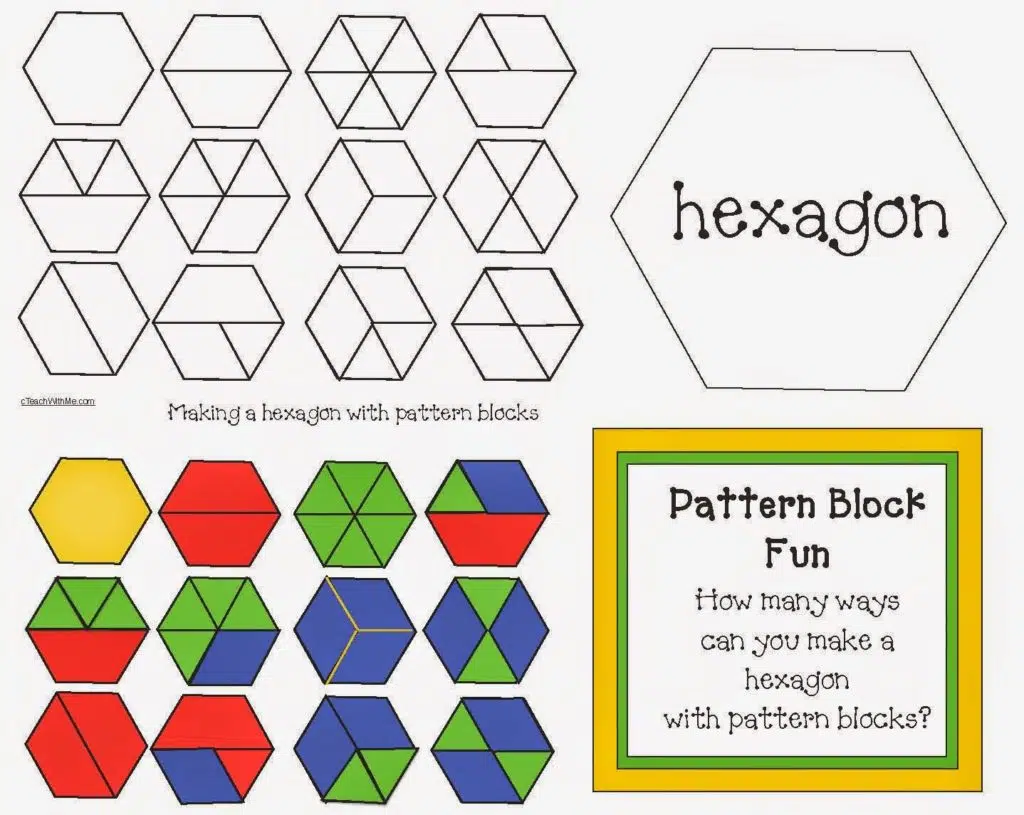
- Puzzle: Pattern Block Hexagon Puzzle
- Description: Given a regular hexagon outline and a set of pattern blocks (triangles, trapezoids, rhombuses), students must fill the hexagon using different combinations of shapes.
- Goal: Explore how smaller shapes can compose and decompose a larger shape.
- Math Connection: Geometry, part-whole relationships, spatial reasoning, equivalence.
- Extension: Challenge students to find all possible combinations to fill the hexagon, or create their own puzzles using specific shape constraints.
- Description: Given a regular hexagon outline and a set of pattern blocks (triangles, trapezoids, rhombuses), students must fill the hexagon using different combinations of shapes.
🧠 Concept: Number Bonds & Addition
- Puzzle: Missing Addends Puzzle
- Description: Students are given a total and must find the correct combination of addends from a set of numbers.
- Math Connection: Addition, number sense, part-part-whole understanding.
- Description: Students are given a total and must find the correct combination of addends from a set of numbers.
Grades 2–3
🧠 Concept: Addition & Number Relationships
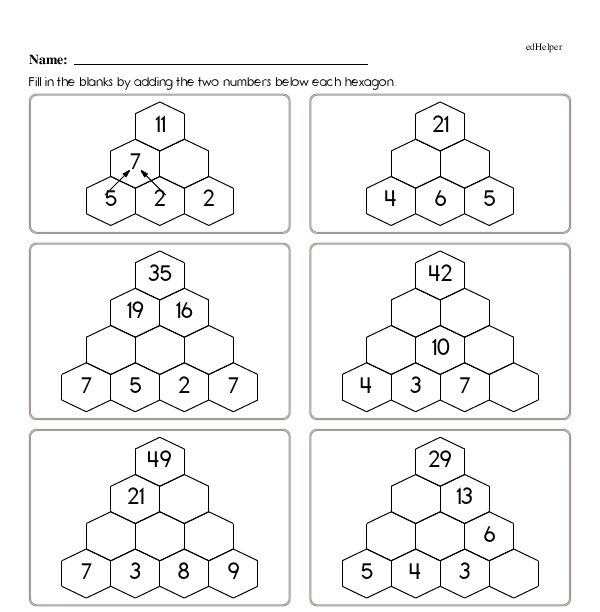
- Puzzle: Sally’s Hexagon Addition Puzzle
- Description: A hexagon is divided into 6 inner sections (typically triangles), and clue numbers are placed on the edges. Students must fill in the missing numbers inside the hexagon so that the sum of each pair of adjacent sections matches the given edge sums.
- Goal: Use logic and addition to find missing values based on relationships between adjacent numbers.
- Math Connection: Addition, number bonds, logical reasoning, problem-solving strategies.
- Extension: Encourage students to create their own hexagon puzzles with new clues or use subtraction to check their solutions.
- Description: A hexagon is divided into 6 inner sections (typically triangles), and clue numbers are placed on the edges. Students must fill in the missing numbers inside the hexagon so that the sum of each pair of adjacent sections matches the given edge sums.
Grades 3–4
🧠 Concept: Multiplication & Arrays
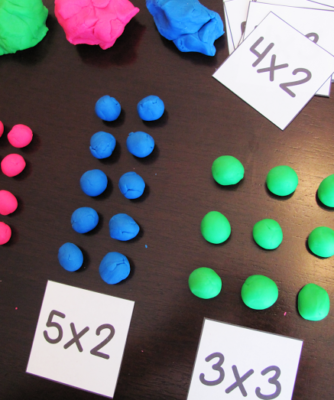
- Puzzle: Array Building Challenge
- Description: Students are given products and must build as many different rectangle arrays as possible with counters or grid paper or using material like coloured beads etc.
- Math Connection: Factors, area models, properties of multiplication.
- Description: Students are given products and must build as many different rectangle arrays as possible with counters or grid paper or using material like coloured beads etc.
🧠 Concept: Fractions
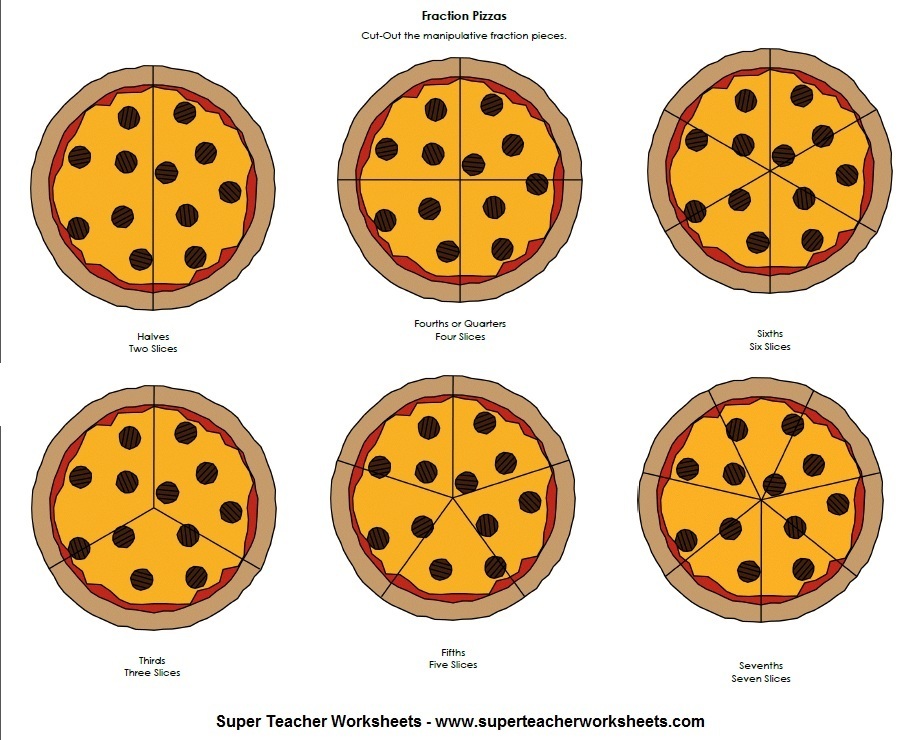
- Puzzle: Fraction Pizza Puzzle
- Description: Students must combine slices of pizza (e.g., 1/4, 1/6, 1/3) to make whole pizzas.
- Math Connection: Adding fractions, common denominators, equivalence.
- Description: Students must combine slices of pizza (e.g., 1/4, 1/6, 1/3) to make whole pizzas.
Grades 5–6
🧠 Concept: Area & Perimeter
- Puzzle: Perimeter Match-Up
- Description: Given a set of shapes and their dimensions, students must match each shape to a perimeter clue or recreate the shape based on a fixed perimeter.
- Math Connection: Measurement, algebraic thinking.
- Description: Given a set of shapes and their dimensions, students must match each shape to a perimeter clue or recreate the shape based on a fixed perimeter.
🧠 Concept: Logical Reasoning
- Puzzle: KenKen or Math Logic Grids
- Description: Students fill a grid using logic and arithmetic rules.
- Math Connection: Operations, constraints, deduction.
- Description: Students fill a grid using logic and arithmetic rules.
Grades 7–8
🧠 Concept: Algebraic Thinking
- Puzzle: Balance Scale Puzzle
- Description: Visual equations using shapes or objects on a balance scale. Students solve for the unknowns.
- Math Connection: Equations, variables, inverse operations.
- Description: Visual equations using shapes or objects on a balance scale. Students solve for the unknowns.
🧠 Concept: Proportional Reasoning
- Puzzle: Ratio Tables Puzzle
- Description: Incomplete ratio tables with clues. Students must fill them in using logical reasoning.
- Math Connection: Ratios, equivalent fractions, scaling.
- Description: Incomplete ratio tables with clues. Students must fill them in using logical reasoning.
🛠️ Puzzle-Based Math Learning at The STEM Makers
The STEM Makers with its activities, focused on hands-on, student-driven exploration—is the right place for puzzle-based learning in math for kids. We bring math learning to life by merging creativity, design, and critical thinking with puzzles and other content. Reach out to us for custom activities for reinforcing mathematical concepts for your kids in a fun and engaging way.
| Methodology | How It Helps Math Learning |
| Design Thinking | Students create their own puzzles, applying math concepts in authentic, creative ways. |
| 3D Modeling & Printing | In collaboration with resource providers students design and fabricate physical puzzle pieces (e.g., tangrams, geometric solids, fraction tiles). [ In pipeline] |
| Coding & Robotics | Build digital puzzles or code logic-based math challenges using platforms like Scratch, Makey Makey, Maker Board or Arduino. |
| Prototyping & Testing | Students test and iterate on puzzle designs — learning mathematical precision and feedback loops. |
| Cross-Disciplinary Projects | Combine math with engineering, art, or science — e.g., build a marble maze that requires angle calculation. |
Image References :
https://www.classroomfreebies.com/2015/03/hexagon-pattern-block-game.html
https://mathsclubs.co.za/activities/build-arrays/
https://www.superteacherworksheets.com/pz-fraction-pizzas.html
https://www.edhelper.com/worksheets/Hexagon-Number-Puzzle.htm