
The workshop began with a strong theoretical foundation, helping students build clarity on what robotics truly encompasses.
What is Robotics?
Students were introduced to robotics as an interdisciplinary field combining:
- Mechanical systems
- Electronics and sensors
- Programming and control systems
- Artificial Intelligence and automation
The emphasis was on understanding robotics not as “just robots”, but as problem-solving systems used across industries.
Applications of Robotics Across Sectors
Real-world applications were discussed and categorized to help students relate robotics to everyday life and future careers:
- Industrial Robotics – Manufacturing, welding, packaging, logistics
- Service Robotics – Cleaning, hospitality, warehouse automation
- Medical Robotics – Surgery assistance, rehabilitation, hospital logistics
- Defense & Security – Surveillance, bomb disposal, unmanned systems
- Domestic & Social Robots – Home automation, assistive robots
Robot Penetration: Current vs Potential
A key discussion focused on the gap between current robot penetration and potential adoption, especially in the Indian context.
- India currently has low robot density compared to global leaders
- Several sectors show huge untapped potential
- This gap translates directly into future demand for skilled and semi-skilled manpower
Students were encouraged to see this gap not as a limitation, but as an opportunity window.
Career Opportunities: Skilled and Semi-Skilled Roles
The session clearly differentiated between:
- Skilled roles: Robotics engineers, programmers, AI specialists, system designers
- Semi-skilled roles: Robot operators, technicians, assemblers, maintenance staff
Importantly, students learned that not all robotics careers require advanced degrees—hands-on skills, practical exposure, and continuous learning can open multiple pathways.
How Can Students Prepare?
Actionable guidance was provided on:
- Building fundamentals in programming and electronics
- Participating in workshops, labs, and competitions
- Using virtual robotics tools to gain experience without expensive hardware
- Developing problem-solving and teamwork skills
The consecutive sessions focused on learning by doing, ensuring students experienced robotics beyond theory.
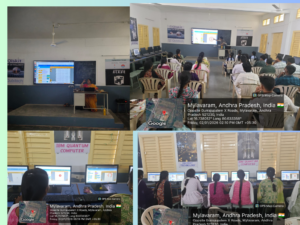
Virtual Robotics Experiments
Using virtual robotics platforms, students explored real-world scenarios through simulation:
- Drivetrain Control
Students learned how robot movement works by controlling the drivetrain to:- Move along specific geometric shapes
- Navigate paths accurately using motor coordination
- Ocean Cleanup Challenge
Students programmed robots to:- Navigate the ocean floor
- Collect maximum trash before the battery ran out
- Optimize movement and time management
- Navigation & Maze Solving
Robots were guided to:- Move from one location to another in a playground setup
- Use markers and logical navigation
- Successfully escape a maze
These activities strengthened understanding of motion planning, energy constraints, and navigation logic.
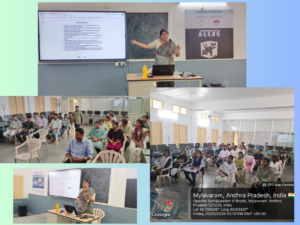
Session on Virtual Robotics at Dr. LHR Govt Degree College Mylavaram
Live Demonstrations Using Physical Robots
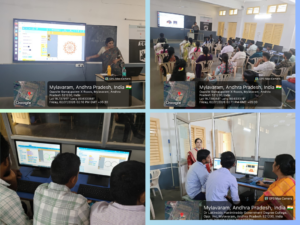
A hands-on demonstration using the Avishkaar Robotics Pro Kit showcased:
- Obstacle Avoider Robot
- Edge Avoider Robot
Students observed how sensors, control logic, and actuators work together in real hardware systems.
Obstacle Avoider demo with Avishkaar kit at Dr. LHR Govt Degree College Mylavaram.
Assembly-Based Learning
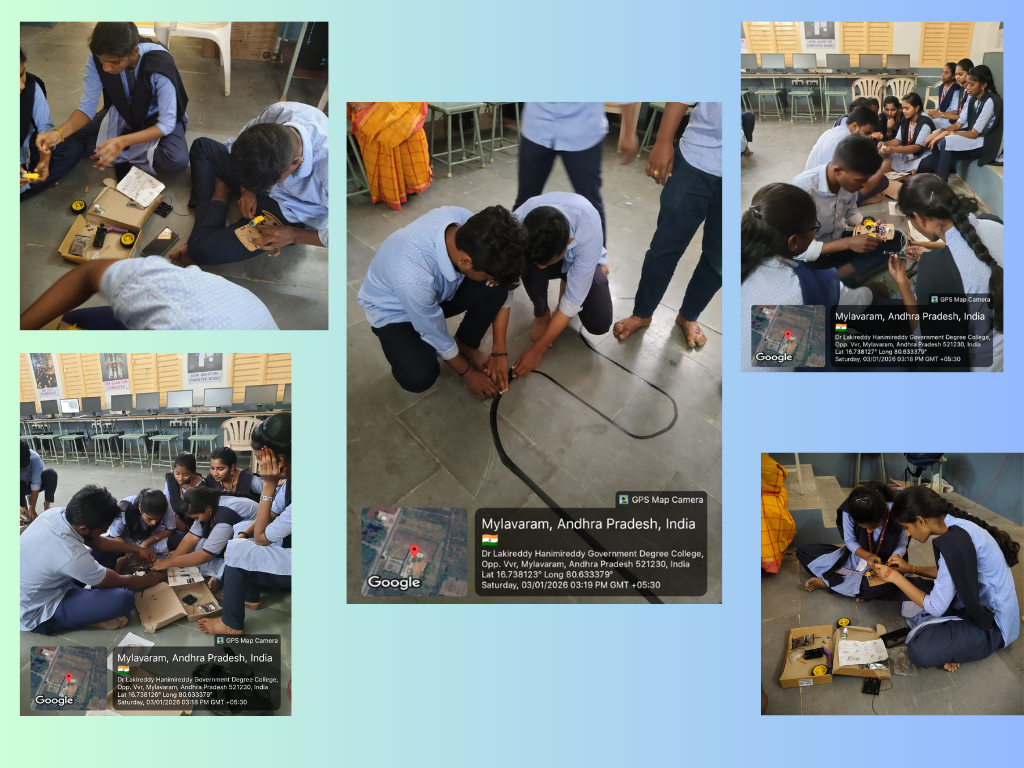
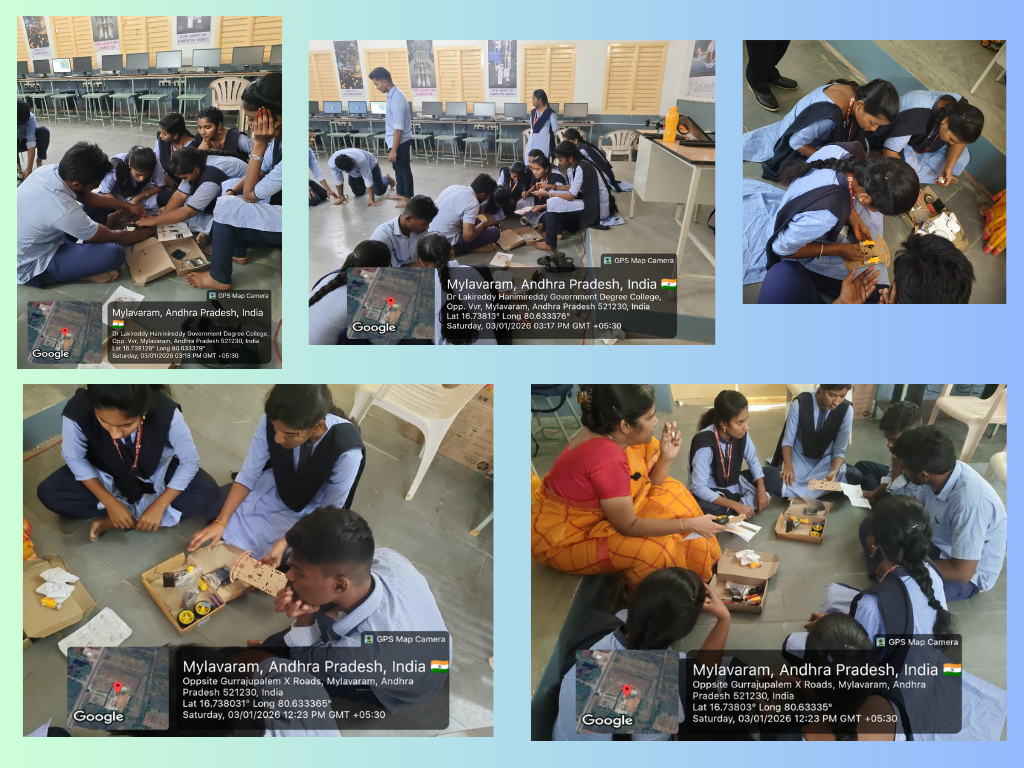
Students were divided into two batches, each working collaboratively to assemble and understand:
- Line Follower Robot using Arduino
- Bluetooth-Controlled RC Car using Arduino
This session helped students gain confidence in:
- Hardware assembly
- Basic Arduino programming
- Team collaboration and debugging
Line follower using Arduino demo at Dr. LHR Govt. Degree College Mylavaram